Monday, October 26, 2026

For Tuesday, October 27

Monday audio. Non-Art.III/DJ/EpY papers due tomorrow.

Prep/Review the rest of Eleventh Amendment. We start where we left off: How did PennEast and Torres change what we thought we knew: Subject to Bankruptcy exceptionalism and the consent of the Spending Clause, Congress cannot subject states to suit under its Art. I § 8 powers?

Friday, October 23, 2026

Creative (or desperate) appellate maneuvers

The U.S. sent California a list of people (about 22k) the U.S. says are ineligible to vote but remain on the California voter roles; it asked for an injunction ordering the state to check its voter roles to remove these (and presumably other) names. The U.S. moved for a TRO prohibiting California from proceeding with vote counting until it checks on these voters; it requested an expedited ruling. The court ordered briefing and a hearing by October 27 (early next week), given the complicated nature of the case and the attempted intervention of voting-rights groups.

The U.S. has appealed the court's refusal to immediately rule on the TRO, arguing that the refusal to rule expeditiously constitutes constructive denial of the TRO. Note two big issues here. First, even accepting the government's constructive-denial argument, denial (constructive or otherwise) of an ex parte TRO is not ordinarily appealable. This case might test if anything remains of the TRO/PI distinction for § 1292(a) purposes. Second, the traditional method for challenging district court inaction has been mandamus, with the high standard it carries. You can see why the U.S. would try something less within the court of appeals' discretion.

Tuesday, October 20, 2026

For Monday, October 26

Tuesday audio. Three-Judge/DJ/Non-Art. III papers due next Tuesday.

Prep the remainder of Eleventh Amendment. We will start with the other facts that define whether an entity is sovereign entitled to immunity. I expect this to take both days next week, with Standing beginning the following week. 

Federal claims or district court?

What we discussed in class yesterday, from the Fourth Circuit.

Monday, October 19, 2026

For Tuesday, October 20

Monday audio.

We will discuss Bankruptcy Courts (which should take about 20 minutes). We then move to Eleventh Amendment. Prep Chemerinsky pp. 395-417, 438-49, and 624-28, along with the Eleventh Amendment itself. Plus, read Galette v. NJT, the Court's most recent statement on sovereign immunity, from last term.

Friday, October 16, 2026

Indian Status as jurisdiction or merits

I posted this case to the Evidence blog because it is largely about whether the defendant's status as an Indian is an element or affirmative defense. But there is an interesting discussion (beginning on p.31) of this as a jurisdictional element and thus whether it goes to the court's jurisdiction or to the merits of the prosecution.

Thursday, October 15, 2026

Magistrate Consent

Dispute in Louisiana and the Fifth Circuit has been going on for several years, where party consented to a magistrate trial, then learned of a longstanding friendship between the mag and the opposing counsel. A prior panel (which we used for arguments a couple years ago) said it looked bad but needed further factual development; a second panel in September said the consent was invalid. An en banc petition is pending.

Tuesday, October 13, 2026

For Monday, October 19

Tuesday audio.

We continue with Non-Article III Tribunals. We will continue with Public Rights, then turn to Magistrates and Bankruptcy Judges; be sure to review the statutes governing both. Look at § 1491 and § 1346(a)(2), then consider the following: What actions are channeled to the Court of Federal Claims and what determines whether it is within the Court of Federal Claims exclusion jurisdiction, as opposed to a federal district court?

Consider two examples involving recent controversies over the Trump Administration trying to withhold or terminate federal grants:

   • The federal government terminates a federal research grant; the researcher sues, arguing that the grant was improperly terminated and that the money should be restored.

   • A school district institutes a policy allowing students to use the bathroom aligned with their gender identity; the federal government threatens to withhold funds; the school district believes any other policy would violate Title IX (prohibiting sex discrimination by recipients of federal funds). The school seeks a declaratory judgment that it is complying with Title IX and that the federal government cannot withhold funds.

Consider the following:

   The Federal Communications Commission (FCC) can investigate regulated entities for violating federal communications law and, following that investigation, may impose monetary forfeiture for the violation. The FCC issues notices of "apparent liability," to which entities can respond; the FCC then can determine liability and assess penalties. Once that assessment has been made, one of two things can happen: The entities can challenge it in the court of appeals, which reviews the FCC order (without a jury). Or the entities can do nothing and the FCC refers the matter to the Department of Justice, which can commence a civil action in district court to recover the amount owed; the civil action is de novo, meaning the FCC's prior determination is entitled to no deference.

   Does this scheme violate the 7th Amendment under Jarkesy? 

We might get to the next panel by late Monday, so Eleventh Amendment should be ready to go. For Monday, prep Chemerinsky pp. 395-417, 438-49, and 624-28, along with the Eleventh Amendment itself. We will do more on Tuesday, depending on how far we get.


Monday, October 12, 2026

For Tuesday, October 13

Monday audio. District Court papers due tomorrow.

We pick on the question of how to determine federal question jurisdiction of a declaratory judgment action? Is there jurisdiction in any of the DJ actions we discussed today? Look specifically at the complaint in MGM.

Then prep Non-Art. III Tribunals. In addition, consider the following:

   The Federal Communications Commission (FCC) can investigate regulated entities for violating federal communications law and, following that investigation, may impose monetary forfeiture for the violation. The FCC issues notices of "apparent liability," to which entities can respond; the FCC then can determine liability and assess penalties. Once that assessment has been made, one of two things can happen: The entities can challenge it in the court of appeals, which reviews the FCC order (without a jury). Or the entities can do nothing and the FCC refers the matter to the Department of Justice, which can commence a civil action in district court to recover the amount owed; the civil action is de novo, meaning the FCC's prior determination is entitled to no deference.

   Does this scheme violate the 7th Amendment under Jarkesy? 

Tuesday, October 6, 2026

For Monday, October 12

Tuesday audio. District Court papers due Tuesday.

For Monday, prep Three-Judge and Declaratory Judgments. For both, consider how these devices respond to and resolve criticisms of EpY. Be ready to analyze the problems provided.

We will get to Non-Article III on Tuesday. I expect this panel will continue until the following Monday, October 19. 

Monday, October 5, 2026

For Tuesday, October 6

Monday audio.

We will finish District Courts. We will begin with the competing principles: "Plaintiff is master of the complaint" and the "Rule Against Artful Pleading." What does each mean and how do they interact?

We then move to the next panel: Three-Judge Courts/Declaratory Judgments/Non-Art. III. For tomorrow, prep the first two pieces. Our starting point for this is Ex parte Young; both three-judge courts and the DJA are response to EpY. Here is a working link for McManus.

Also, here is the transcript and audio for the Suncor argument.

Thursday, October 1, 2026

Shadow Docket orders and cert grants

SCOTUS on Wednesday issued an order staying an injunction prohibiting the Administration from deporting people third countries (countries other than of their origin) without process and granting cert. Three justices dissented, although no one wrote anything to explain.

Two things of note.

First is to consider how the balance of equities could have worked here. Staying the execution means some plaintiffs will be deported to third countries where they might face torture; that is not remediable should the Court affirm the lower court. We can assume the Court's view that any limitation on the executive's ability to pursue its policy goals is a harm that dominates the balance.

Second, the Court granted cert on four questions. The last is: "Such other questions that the Government determines are appropriate for the proper disposition of the case." Court commentators insist they have never seen this done before. The Petitioner (the government in this case) frames and controls the QP, although the Court must approve it. Blanket permission to the petitioner to raise whatever issues it chooses is something very new. Recall that granting cert on narrower questions (rather than the case) was an unintended (at least by Congress) development. But having moved to reviewing questions, the Court does something very different in granting the petitioner carte blanche as to what it raises.

Tuesday, September 29, 2026

For Monday, October 5

Tuesday audio. Court of Appeals papers due Monday.

Prep the remainder of Arising Under. We begin with the distinction among three things--legal rights, jurisdictional grants, and rights of action; what are the differences and how do they affect whether a claim arises under?

Consider the following, in light of Morrison:

The US prosecutes X for sex trafficking. The purported basis for jurisdiction is 18 U.S.C. § 3231, granting district courts original jurisdiction over "all offenses against the laws of the United States." The sex-trafficking statute requires that the defendant's actions be "in or affecting interstate commerce."  The court determines that the use of money and a car manufactured in another state does not satisfy that requirement and so the prosecution must be dismissed. What is the basis for that dismissal?


Monday, September 28, 2026

For Tuesday, September 29

Monday audio. Court of Appeals papers due next Monday.

We pick up with the distinction between exclusive and concurrent jurisdiction in district courts and how that affects which statutes you cite for jurisdiction.

Prep all of Removal, Exclusive Jurisdiction,  and Arising Under: Arising Under.

Thursday, September 24, 2026

On writing

Count me on the more formal side of this discussion.

TROs and appeals

Judge Timothy Kelly (D.D.C.) issued a TRO against the White House stripping three news outlets of press credentials. The court resolves the case on due process grounds--the failure to provide notice prior to taking away the credential.

The relevant points for our purposes come on pp 7-8.

First, the court declines to stay the TRO, pointing out that 1) TROs are not "generally unappealable" and 2) the whole point of a TRO is to immediately-but-temporarily preserve the status quo, a purpose undermined by a stay. As to # 1, courts of appeals have been allowing appeals of TROs in Trump-related litigation, albeit without explanation or applying the established criteria for treating a TRO as a PI. Judge Kelly emphasizes the 14-day duration, highlighting the key feature that makes something a TRO rather than a PI.

Second, FRCP 65(c) requires the court to impose a bond on the plaintiff obtaining the injunction--some money to cover the costs the defendant's suffer from a wrongly issued injunction. This was looming as in issue in the antitrust litigation over the Paramount merger, where Paramount was seeking a bond in the billions of dollars. In constitutional cases such as this one, courts tend to impose nominal bonds of $ 1, since the government's cost (inability to enforce a law or policy for a time) are not monetized. Judge Kelly did that here.

But note that this was a point of discussion in 2025, where DOJ was threatening to seek substantial bonds in constitutional cases. Many feared this would chill constitutional litigants and lawyers, who do not have the funds to post substantial bonds, from bringing litigation.

Update: Prof. Vladeck offers some thoughts on how the distinction between TRO and PI has collapsed, especially around stays and appealability.

Tuesday, September 22, 2026

For Monday, September 28

Tuesday audio.

Some last-minute clean-up on Courts of Appeals. Papers will be due the following Monday (October 5).

We then start District Courts. Prep Structure, Jurisdictional Overview, and Well Pleaded Complaint. 

Saturday, September 19, 2026

SLAPPing COD

The Fifth Circuit with a new decision again holding that state SLAPP laws do not apply in federal court (you can review the Erie analysis for fun). For our purposes, it has a lengthy discussion of the multi-prong circuit split on whether the denial of an anti-SLAPP motion (often because the motion does not apply in federal court) falls within the COD.

Fair game for a reaction paper. Definitely on next year's oral arguments. 

Friday, September 18, 2026

§ 1257

One of our argument cases, which SCOTUS will hear this year, is Suncor Energy v. Cty. Commissioners of Boulder, on the issue of whether § 1257 and Article III allow SCOTUS to review a decision of the Colorado Supreme Court. Here are competing views on the question that might be useful for argument or just for understanding SCOTUS review of state courts.

Thursday, September 17, 2026

COD and anonymity

First circuit decision affirming an order denying leave to proceed anonymously and refusing to close a trial. FN 9 explains why both orders are immediately reviewable.

Tuesday, September 15, 2026

For Tuesday, September 22

Tuesday audio. No class on Monday. I will try to plan make-ups for the two classes (next Monday and Labor Day) that we missed.

Prep and review Interlocutory Orders.

Just in case, District Courts should be ready to go; prep Structure. Then we will really get going with that the following Monday. 

Monday, September 14, 2026

For Tuesday, September 15

Monday audio. SCOTUS papers due at the beginning of class.

Here is FRAP 3 and FRAP 4, for your information.

We pick up with Mohawk--what was wrong with the Court's explanation on the third prong, how else could a party gain review, and how might you distinguish the denial of anonymity. Consider the distinct approaches to the third prong between the majority and Justice Alito.

Prep Interlocutory Orders. As part of that, have a look at this new Order dealing with § 1292(b) certification.

Wednesday, September 9, 2026

Navy Court of Criminal Appeals Argument

At 9 a.m. on Tuesday, September 29 at St. Thomas. You should be able to make it back in time for class.

We will discuss the military court structure later this month. 

Tuesday, September 8, 2026

For Monday, Sepetmber 14

Tuesday audio. Supreme Court papers due on Tuesday. Please add ten (10) points to the scores for the papers you just got back--I mistakenly graded out of 40 instead of 50. Sorry.

Prep Finality and Collateral Order. Read GEO carefully; it clarified and confused some things about the collateral order doctrine. Try to parse the differences between the majority and Justice Alito.

We will get to Interlocutory Orders later on Tuesday. 

Information for the Constitution Day program with Prof. Rabban. Pizza, participation points, and a great academic experience will be provided.

Papers

Add 10 points to your paper scores. I forgot that I had upped the value from out of 40 points to out of 50 points. Sorry for the confusion.

Oral Arguments

Order granting certiorari.

We have 17 cases. To manage the load and create shorter days, we will split across two days: Five cases on Wednesday, twelve on Thursday. 

Because we have an odd number in the class, Roberts v. Progressive has only one attorney assigned to argue. I also need a volunteer to judge a second case.

The order identifies the judges and counsel for each case. Between now and early November, you must meet with your co-judge to decide who will be chief and your opposing counsel to decide which side you each will represent.

The first name in the case title is Petitioner (loser below). In one case the issue being reviewed is a cross-petition by the winner below. Several cases are listed twice; distinct attorneys and judges will handle distinct issues.

You may write your reaction paper on these cases (if related to the subject of the class panel) so long as you are not assigned that case as judge or counsel.

Thursday, September 3, 2026

Justice Breyer on much of our class so far

H/T: Dov.


At 6:50 he begins discussing the shadow docket; at 8:40 arguments for and against writing opinions for decisions on the shadow docket.

At 18:00 they begin an extended discussion on politics and the Court; at 33:10 that topic continues with Justice Breyer mentioning the "the temperature of the day" vs "the climate of the era."


The unnecessay rhetoric of judical supremacy

The District of Maryland enjoins the executive branch from enforcing the new anti-birthright citizenship E.O. 

The court explains why the new E.O. violates the 14th Amendment as interpreted in Barbara; good enough. But then see the bottom of p.26:

The Supreme Court has spoken: Children in the certified class are “citizens at birth.” Barbara, 146 S. Ct. at 2450. Barbara is the law of the land. The President must follow it. See Marbury v. Madison, 5 U.S. 137, 178 (1803) (“It is emphatically the province and duty of the judicial department to say what the law is.”).

I wrote some ideas here. We did not cover a different angle on the judicial supremacy/departmentalism debate: The President (and Congress) must be able to test the scope of judicial precedent by attempting to enact a new law or policy and seeing (via new litigation) whether the courts find the new policy consistent with their constitutional interpretation. The only way to trigger further judicial review is by enacting and enforcing a new policy, triggering new litigation challenging that policy.

And this is non-partisan. President Trump, the Court having declared invalid his initial broad anti-birthright-citizenship E.O., can attempt a scaled-back effort to limit birthright citizenship and see what the courts do. Similarly, President Biden, the Court having declared invalid his attempt to forgive student loans under one law, could attempt a smaller effort under a different law and see what the courts do (they declared the second effort invalid). But any President must have room to try.

Wednesday, September 2, 2026

Court Size

House GOP effort to stop court expansion through constitutional amendment fails (no surprise--no way they would have gotten 2/3). This was largely a political stunt.

But note the opposite story some will seize from this: Attempting (and failing at) an amendment to freeze SCOTUS size highlights to an otherwise-unaware public that the current Constitution is silent as to Court size and thus a new Democratic-controlled Congress can, consistent with the Constitution, alter that size as it wishes.

Don't expect this to happen. But it will be a discussion in the next few years. 

More on the ballroom decision

The ballroom decision turns a lot on standing, which we will get to later in the semester, so I don't want to throw too much of it at you. But take this away: Standing in this case was at least arguably proper (as the dissent argues) under controlling doctrine allowing standing based on "aesthetic" concerns in environmental cases. One way of reading the ballroom decision is the majority pulling back on that environmental standing. Again, we will come back to this in the Standing section of the class.

But this piece by Prof. Michael Dorf (Cornell) raises a specific problem related to the shadow docket: A court should find the merits prong of the stay inquiry satisfied only if the lower court erred in understanding or applying existing law; a stay decision is not proper where the Court wants to change that law. But it appears that in this case the majority granted the stay because the  lower court erred and the government is likely to succeed under what the majority plans/hopes/wants to turn the law into. The plaintiff (at least arguably) had standing under current standing law; the plaintiff does not have standing under a narrow approach to standing law.

The same is true with the firing cases from two years ago. Firing members of the Merit Systems Protection Board was improper under Humphrey's Executor; an injunction stopping those firings should have remained in effect (because the government was unlikely to succeed) until the Court overruled Humphrey's Executor. When the Court granted that stay, everyone knew Humphrey's days were numbered.

Tuesday, September 1, 2026

Upcoming Event: The First Amendment Law of Academic Freedom

Our Constitution Day 2026 program will feature Prof. David Rabban (University of Texas), presenting The First Amendment Law of Academic Freedom. This will be at 12:30 on Tuesday, September 15 in the Large Courtroom.

Class participation points awarded for attendance. Please attend; this is an especially important topic for students in this moment.

For Tuesday, September 8

Tuesday audio. No class on Monday; enjoy the long weekend.

We will finish Supreme Court. If "final" does not mean "nothing left to do in state court," what has the Court defined it mean? What are the four categories of finality in Cox Broadcasting?

We then move to Courts of Appeals. For Tuesday, prep Structure and Finality. Note GEO as an assigned case; this is the Court's most recent statement on the collateral order doctrine that clarified some things. 

Monday, August 31, 2026

New Shadow Docket Order

Staying the injunction prohibiting construction of the Ballroom. 5-4, with Chief Justice Roberts (who had issued a temporary administrative stay last week) joining the three Democratic appointees.

The majority does write something. The main grounds was the conclusion that the plaintiffs likely lack standing (we will come back to this opinion on this point later in the semester); the opinion may be most significant on that point. Part has a brief discussion of irreparable harm and the balance of the equities.

For Tuesday, September 1

Monday audio.

Here is the Motion for Leave to File in Iowa v. Arizona. 

A couple quick final points on the interim docket: 1) One criticism of the Court's practices is the absence of an opinion explaining the stay, especially when the lower court applied existing law but SCOTUS is looking to change the law. It was clear that Humphrey's Executor was not long for the world when the Court granted a stay even though the firing was unlawful under HE. 2) This, of course, undermines law declaration, because the lower courts do not know what to do. 3) Justice Kavanaugh wrote a concurring opinion in CASA (not in your excerpt) praising this practice of increased-and-earlier SCOTUS involvement in major constitutional cases involving important new federal laws or regulations.

Prep all of Reviewing State Courts. This will take us through tomorrow and into next Tuesday. As you look at § 1257 (both current and pre-1988), identify five classes of cases SCOTUS can hear (3 express, 2 by implication). Pre-1988, SCOTUS jurisdiction (or its nature) depended on the outcome in state court; why draw distinctions, given the purposes of SCOTUS review?

Friday, August 28, 2026

Vladeck, History of Certiorari

The One First Long Read: The History of Certiorari

The first thing to say about “certiorari” is that lawyers can’t even agree if the word has four syllables or five. We often just shorthand it to “cert.” to save everyone the trouble. But however you pronounce it, there’s no denying the central role certiorari has played in the evolution of the Supreme Court as an institution, and the Court’s ability, for better or worse, to operate as it does today. In this first installment of the One First “Long Read,” we take a brief tour through the history and evolution of this obscure but critically important procedural device.

As law professor Ed Hartnett wrote in 2000, February 13, 1925 was the day on which “the modern Supreme Court was born.” No major decision was handed down on that date; no new Justice took the (two) oaths of office. Rather, it was on that otherwise nondescript Friday that President Calvin Coolidge signed into law the Judiciary Act of 1925—known then and now as the “Judges’ Bill,” entirely because it was the judges (technically, the Justices) who were behind it.

The Judges’ Bill fundamentally transformed the Supreme Court’s docket. For the Court’s first 101 years (from 1790 to 1891), the Justices had no discretion over whether or not to hear an appeal. Congress repeatedly tweaked which cases could be brought to the Supreme Court, but everyone understood that the Court’s “appellate jurisdiction” in whatever cases Congress prescribed was “mandatory”; if the Justices could hear an appeal from a lower state or federal court, then they had to do so. 

In the decades after the Civil War, however, the Court’s docket (like that of lower federal courts) had exploded. Whether because of litigation arising out of the Reconstruction Amendments; the dramatic expansion of the federal government; the growing proliferation of federal regulation; or some combination of all three, the Supreme Court by one point in the late 1880s had over 1800 cases on its docket—with some estimates placing the Justices more than three years behind in clearing the backlog.

In the 1891 Evarts Act, Congress for the first time gave the Justices a modicum of control over their docket. In four classes of cases that were perceived at the time as relatively less important, the Court could choose whether or not to exercise jurisdiction by granting a “writ of certiorari.” And although the statute didn’t say so, it eventually became the Court’s practice (which, to this day, has never been codified in any statute or rule) that it takes four votes to agree to take up such an appeal, not five.

“To be more fully informed” in Latin, a writ of “certiorari” was an unusual but not unheard-of mechanism used by English appellate courts of the same era to take up cases from lower courts. The idea under the 1891 Act was to pick sets of cases then seen as generally insignificant, and spare the Justices of the need to explain themselves if a specific appeal was turned away. Thus began not only the “rule of four,” but also the practice of unexplained “denials” of certiorari—cursory orders in which permission to appeal one of those four types of cases was denied.

But the innovation of certiorari in the 1891 Act did very little to reduce the pressure on the Court’s docket. And Congress only added to that pressure in 1914, when it gave the Justices, for the first time, the power to hear appeals from state courts in cases in which the state courts had ruled in favor of a federal claim (from 1790–1914, the Supreme Court could review only those state court decisions rejecting federal claims). Although these appeals, too, came via certiorari, now, they were only adding new cases to the Court’s docket.

Thus, by 1925, the Justices themselves (led by Chief Justice, and former President, William Howard Taft) were some of the loudest proponents of giving the Court more discretion over its docket—not just over new types of appeals, as in the 1914 Act; or unimportant types of appeals, as in the 1891 Act, but over all appeals. 

Taft didn’t hide his motivations. In an influential 1908 article published while he was running for the White House(!!), he had argued that the Supreme Court’s function was not to resolve individual cases, but rather to “cover the whole field of law upon the subject involved.” In a 1910 speech, then-President Taft directly connected the vision of the Supreme Court as a general expositor of legal principles to discretionary review of specific appeals. And after joining the faculty at Yale Law School at the end of his presidency, now-Professor Taft explicitly urged Congress in 1916 to do away with the requirement that the Justices hear appeals except in cases involving interpretations of the federal Constitution. 

For Taft, it wasn’t just that the Justices were overworked; it was that a Court without discretion to pick and choose its cases couldn’t truly function as a constitutional court, because it would forever be deluged and distracted by technical appeals that, whatever their significance to the parties, were inconsequential to the nationwide development of the law. A supreme court, in Taft’s view, was one that controlled its docket, and not one that was told which cases to resolve.

In the Judges’ Bill, Congress (largely) acquiesced in Taft’s vision. Under the 1925 Act, the Supreme Court would have discretion to decide whether to hear all appeals from the federal intermediate appeals courts (but would still have to hear appeals from state courts when the state courts rejected a federal claim). And in 1988, Congress would finish Taft’s work—giving the Court discretion even over those appeals from state courts, as well. Today, the only appeals that the Supreme Court must hear are the two categories of cases that Congress requires to be heard by special “three-judge district courts”: challenges to congressional reapportionment; and certain challenges to campaign finance laws, appeals from which go directly to the Justices. During the Court’s most recent Term (the October 2021 Term), exactly one of the 58 cases resolved through a signed opinion came from a three-judge district court (thanks, Ted Cruz!); the other 57 were all cases the Justices chose to decide.

The shift toward certiorari gave the Justices discretion to pick and choose which cases they decide based upon criteria that would be entirely up to them. But Taft took it even further. Contradicting representations he had made to Congress while testifying in support of the Judges’ Bill, the Court also quickly claimed the power to decide only specific questions within the cases they were choosing to hear. 

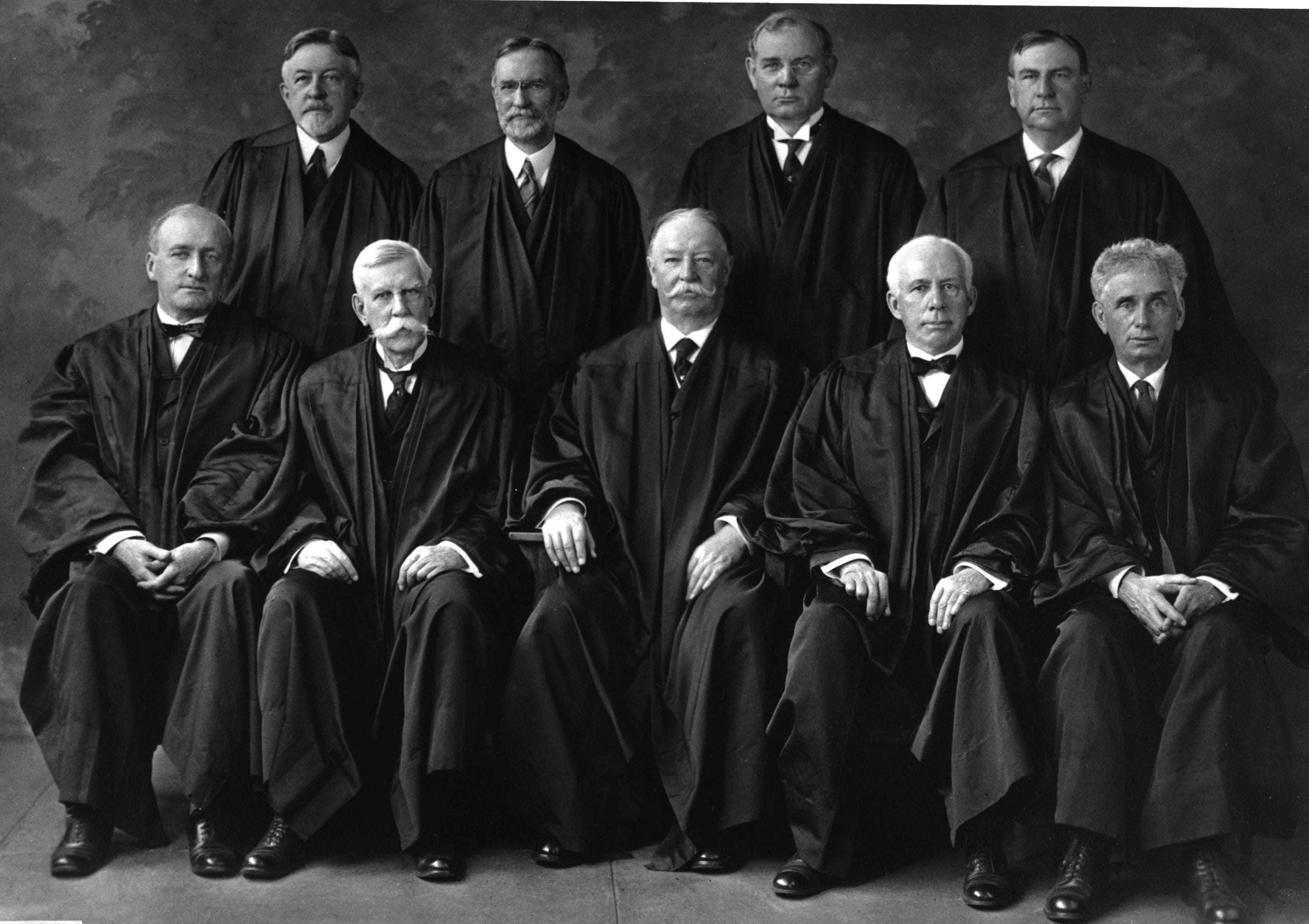
In one of the most prominent early examples, a 5-4 majority in Olmstead v. United States held that wiretaps of telephone calls did not require warrants under the Fourth Amendment even though, as three of the four dissenters argued, the case could have been resolved in Olmstead’s favor on other grounds. It was Taft, writing for the majority, who explained that the Court had agreed to resolve only the constitutional question. (Below is a picture of the Supreme Court that decided Olmstead in 1928; by tradition, Taft, as Chief Justice, is front-row center, and the rest of the Justices alternate to his right, then his left, in seniority order.)


That’s why today, a “cert. petition” (a “petition for a writ of certiorari”) must begin with the “Question(s) Presented” for review. Thanks to certiorari, the Supreme Court doesn’t actually hear appeals; it hears questions it has specifically chosen to hear within appeals. And in a growing number of cases, the Justices will even write their own questions when granting certiorari (as in the major Second Amendment case the Court decided this June), rather than relying upon the questions presented by the parties. 

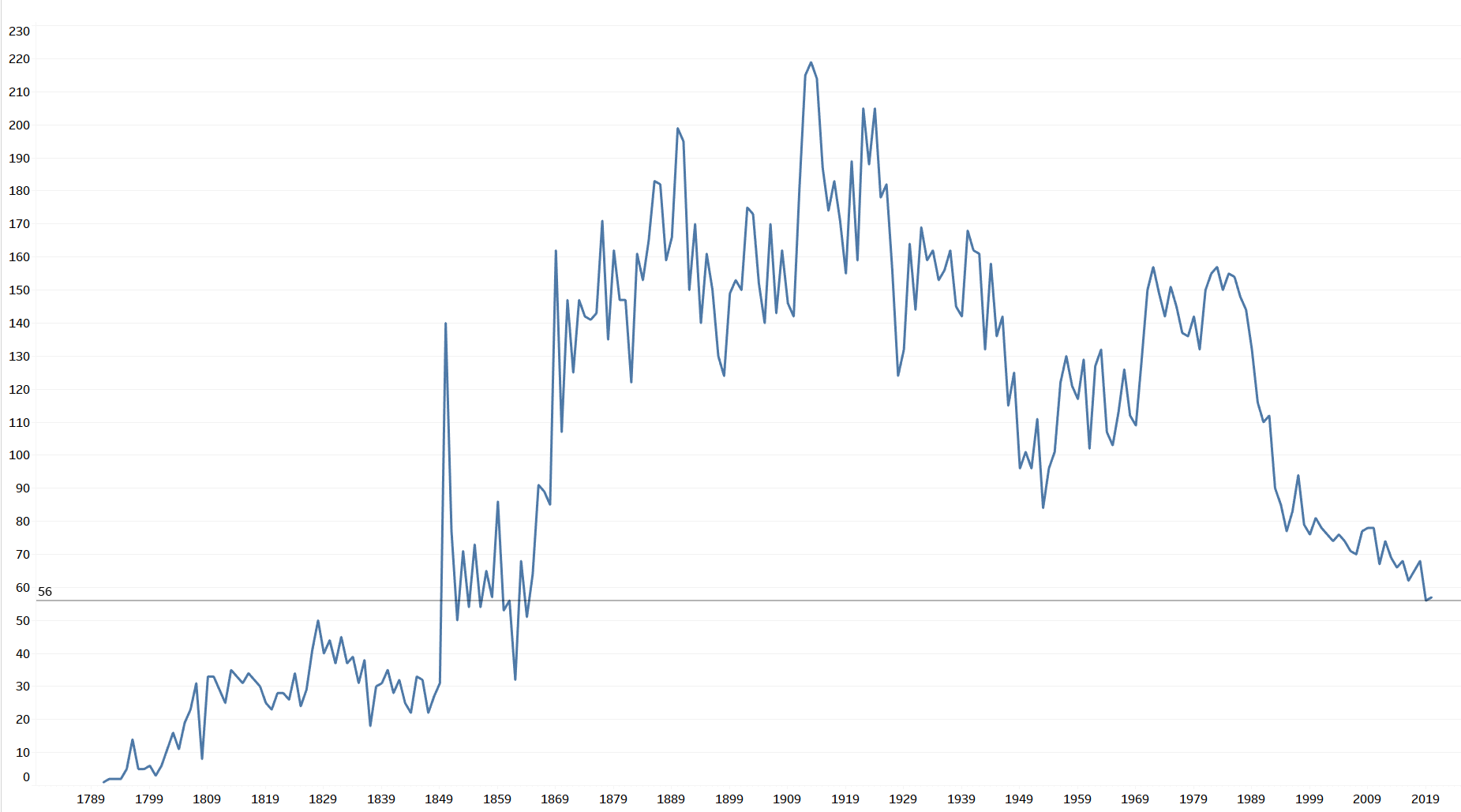
So it’s not just that the Court is hearing fewer and fewer cases each year (per the below graphic from Dr. Adam Feldman that shows the total number merits decisions by Term ); it’s that the Court is deciding a small number of carefully curated (and sometimes internally generated) questions within that self-selecting subset:


In a future issue, I’ll talk more about the universe of strategic and tactical behavior that the rise of certiorari has begotten, including how the Justices themselves manage the “cert. process.” The relevant point for present purposes is that the contemporary Supreme Court is defined by certiorari—by the discretion the Justices have to set their own agenda. As Professor Hartnett has put it, “the Supreme Court’s power to set its agenda may be more important than what the Court decides on the merits.” At the very least, understanding that today’s Supreme Court, with few exceptions, decides only cases the Justices agree to take up (and only specific questions within those cases) puts what the Court does decide on the merits into rather important perspective.

And whatever its merits, that perspective seems like a fitting place to begin any sustained discussion of the Supreme Court of the United States. We’ll pick the story back up next week…

Thursday, August 27, 2026

Criticizing judges

Steve Vladeck writes (this is a free link of a paywalled piece, so please do not share) about the controversy over James Percival, a Trump Admin attorney, and the question of criticizing judges.

We did not discuss the question of judicial criticism, although it fits within our discussions of impeachment and judicial activism. This might be fair game for a Panel # 1 reaction paper.

Please note that this first section of the class is more theory- and policy-based than case-based, so your reaction papers will be similarly theory- and policy-based. But the rules of good legal writing--state and explain the legal principles, apply them to a problem--remain the same. These can be "reaction" papers--reacting to and responding to the materials we have read.

Tuesday, August 25, 2026

SCOTUS Responsibilities

A proposal.

One could link this to the idea of court expansion. We have nine justices but 13 circuits (12 regional plus the Federal Circuit). Add four justices and have their home chambers in the regional circuit.

For Monday, August 31

Tuesday audio. Foundations papers due at the beginning of class Monday. I know this section is a bit more theoretical or policy-based than others, but that gives you a bit more freedom to write. Because it relates to the discussion of term limits, you may discuss the SCOTUS reform proposals as they relate to the constitutional foundation things we discussed in Panel # 1.

We continue with Original Jurisdiction. What other policies justify Wyndotte? How does § 1251(a) raise a special problem under Wyndotte and how does the Court get passed that?

Then move to Mandatory/Discretionary; include  S. Ct. R. 14.1 and S. Ct. R. 10. Then prep Review of Federal Courts of Appeals and Reviewing State Courts, covering Background, Power of Review, and Independent and Adequate. I hope to just about finish SCOTUS by next Tuesday.

Monday, August 24, 2026

Panels (All)

 After the jump. Please review and make sure you have been assigned to three (3).

For Tuesday, August 25

Defect in Monday's audio. Sorry. 

We pick up with the benefits and defects in the Segall plan. Review and Prep Structure and Rule, Discretionary or Mandatory, and Original Jurisdiction. Prep Review Federal Courts of Appeals, which we may get to at the end of the session.

Judge Stephanos Bibas on writing

Here. He focuses on judicial opinions, but the advice translates to all writing.

Tuesday, August 18, 2026

For Monday, September 24

Tuesday audio.

We will cover some final things on Foundations. First, how do the various opinions in CASA map onto the judicial supremacy/departmentalism debate? What is the consequence of departmentalism if the court finds that the citizenship E.O is invalid? Second, consider the concept of "judicial activism;" review the piece by Orin Kerr on the Supplemental Materials post.

We then move to Supreme Court; please check who is on Panel # 2. Prep Structure and Role, Discretionary Jurisdiction, and Original Jurisdiction. 

I will post the final panels next Monday afternoon. 

Monday, August 17, 2026

For Tuesday, August 18

Monday audio. We will discuss syllabus, assessments, etc. for the first few minutes of class tomorrow. Please email me if you have an exam on Wednesday, December 16.

Couple things to flag: This post from Prof. Steve Vladeck includes a chart showing the fifteen judges who have been impeached.

We continue with Constitutional Structure; prep the rest of this section. See also this post from Prof. Vladeck offering statistics on SCOTUS appointments by President. What is the connection between "life tenure" (as Moshe and everyone else puts it) and "good behaviour" and "permanent tenure of office?" What is the argument that Congress could impose term limits or mandatory age limits on judicial offices under the current language of Art. III?

Thursday, August 6, 2026

Welcome to Fed Courts and First Week Assignments

Welcome to Federal Courts. 

This blog is the primary means for out-of-class and between-class communication.

Please download and read the Syllabus for complete details about the course, assignments, pedagogical approach, grading methods, and course rules. Review it prior to the first class.

You should bring the Syllabus with you to every class.

Please download and review Grading Information for details about assessments and graded assignments for the course. I will answer questions about this prior to the second class, on Tuesday, August 18.

Here are Discussion Questions that we will use to guide class conversations for each topic. You now have most of the questions for the entire semester, although I may provide more in advance of a particular class. You should print this and keep it with the Syllabus to help prepare for each class.

And remember: 

First Amendment cases often get serious attention, and rightly so. But civil procedure, though perhaps less glamorous, defines the rules of the road.  

Required Course Materials:

1) Erwin Chemerinsky, Federal Jurisdiction (9th ed. 2025) (“Chemerinsky”)

2)  James E. Pfander, Principles of Federal Jurisdiction (4th ed. 2022) (“Pfander”)

3) Federal Courts Blog. All materials can be found on the Blog at Supplemental Materials, as indicated in syllabus; you should bookmark this page, because you will come back to it a lot.


Assignments for First Day+ of Class: After the jump


Introduction: Federal Courts and Constitutional Structure

   Provisions:

   U.S. Const. art. III

   U.S. Const. art. II § 2 cl.2 (appointment); Art. I § 4; Art. I § 2, cl.5-6 (impeachment)

   U.S. Const. art. I, §§ 8, 9

   U.S. Const. art. VI, cl.2-3

   U.S. Const. amends. X, XI, XIII, XIV, XV

   Maps of the Federal Judicial System (Blog)

Theme: History and Constitutional Foundations                     Chemerinsky 1-16

                                                                                                       Pfander 1-22

   Cases:

   Marbury v. Madison


   Commentary:

   The Federalist No. 78 (Blog)

   The Federalist No. 79 (Blog)

   Chervinsky, Chase Impeachment (Blog)

   Vladeck, Impeaching Federal Judges (Blog) (chart)

Theme: Separation of Powers, Parity, Comity, Federalism       Chemerinsky 26-43, 40-44

                                                                                                          Pfander 22-26, 32-36

Theme: Judicial Activism

Theme: The Judicial Role

   Cases:

   Trump v. CASA (Blog)

Theme: Judicial Supremacy and Judicial Departmentalism     Chemerinsky 16-17

                                                                                                          Pfander 22-23

   Cases:

   Trump. CASA (Blog)

Theme: Good Writing and Talking Procedure

   Commentary:

            Good Writing and Talking Procedure  (Blog)


Consider the assigned Discussion Questions.


Panels (Preliminary)

As you see from the Syllabus and Assessments, everyone is assigned to three (3) panels during the semester and will write their papers on that topic. Panels are assigned at random, although no one sits on consecutive panels and assignments are somewhat distributed through the semester.

Below are assignments for the first two panels. Structure will go on the first class on Monday, August 17; panelists should sit on the side of the room nearest the door. I expect to get to Supreme Court late in the second class and then into the second week of the semester.

I will assign final panels at the beginning of the second week of class, once I know the final class roster.

Federal Courts and Constitutional Structure

Moshe Fettman                          Anne-Marie Issa

Alyssa Lopes                             Tariq Ishtiaq

Chloe Kortie                             Leila Halili

Angeline Garces                         Jonathan Suarez

Joshua Ynirio                            Elizabeth Gonzalez


Supreme Court of the United States

Alexa Crea                                Rebecca Lopez

Erika Rosner                             Ki Gebhardt

Justin Bigney                             Lauren Ayala

Camila Amaya                           Valentina Correa Ospina

Ashley Miranda                          McKenzie Kreitlein

Jonathan Suarez